‘World-first’ methanol refit completed on giant Cosco container ship
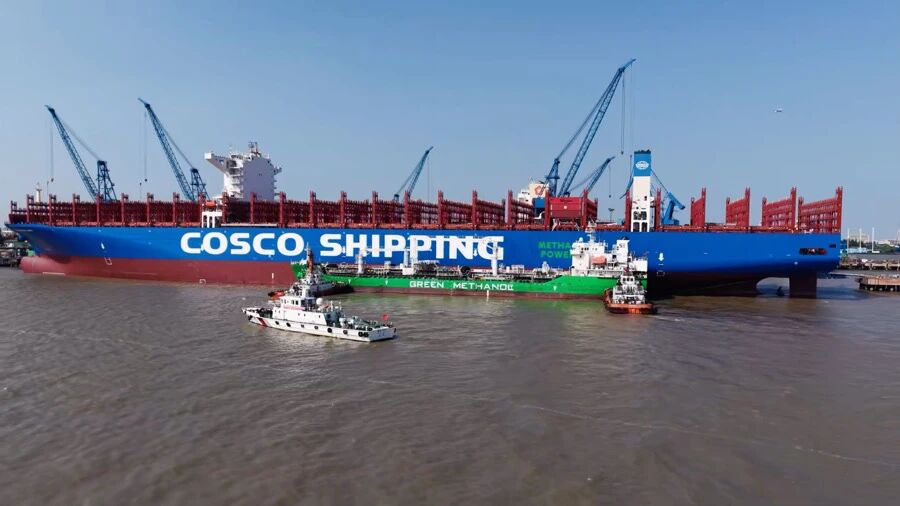
The world’s first conversion of a giant Everllence two-stroke engine to run off methanol fuel has been completed in China.
The conversion was on board the 20,000-teu Cosco Shipping Libra (built 2018),
which has now completed its sea trials.
The vessel’s single 11-cylinder, 90-bore main engine was converted to be able
to take liquid gas injection methanol or regular diesel.
The work was done by engine maker Everllence and Cosco Shipping Heavy
Industries.
The project covered engineering, project management, installation,
commissioning and sea trials.
As part of the project, Everllence built a dedicated testbed in Japan to
validate the performance of a 90-bore engine.
Everllence PrimeServ vice president Michael Petersen said: “This milestone
highlights Cosco Shipping Lines’ role as a first mover and presents a practical
path for reducing emissions from Everllence S90 engine vessels.
“It also showcases Everllence’s capability to deliver large-scale retrofit
projects.”
Everllence, formerly MAN, believes there are more than 300 vessels with its
S90-class engines that are suitable for retrofitting.
“While the journey toward full decarbonisation will require collaboration
across the industry, this achievement demonstrates that large-scale conversions
are both technically proven and commercially viable,” added Petersen.
“This opens a practical pathway towards accelerating the maritime energy
transition together with our customers.”
Earlier this year, Everllence teamed up with Meyer Group in Germany to offer
methanol retrofits.
Everllence is also working on plans for large methanol dual-fuel engines for
newbuilding orders.
In May this year, it said it was set to deliver its most powerful two-stroke
methanol engine.
The 12-cylinder, 95-bore methanol dual-fuel engine has been developed with
Chinese licensee CSSC-MES Diesel.
There are 12 of these engines destined for a series of 24,000-teu vessels.
Competitor WinGD has also been advancing its methanol dual-fuel engine
portfolio.
Its 10-cylinder, 92-bore dual fuel engine has been delivered to Cosco Heavy
Industry (Yangzhou) shipyard, China, for installation on a 16,000-teu Cosco
Shipping vessel.
(Trade Winds)